Background
The term 'moving image education' refers to learning and teaching practices which develop moving image media literacy.
These practices involve analysing moving image texts, creating them, exploring, appreciating and sharing them, and being discerning about them. This is neatly expressed in the widely accepted '3Cs' of media literacy: the cultural, the critical and the creative. These three aspects have shaped the design of this website.
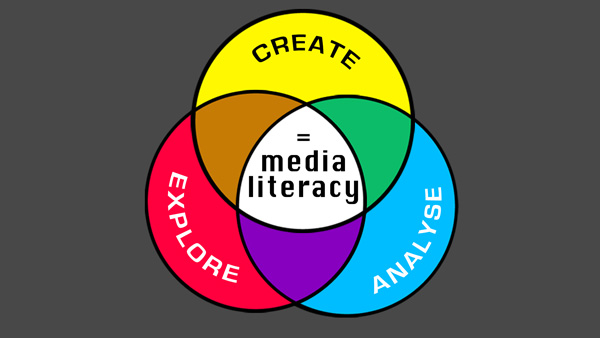
Many view the '3 Cs' as overlapping parts of a whole, each enriching and supporting the other aspects, rather than separate and distinct learning activities.
Why do we need it?
Because moving images dominate global culture and communication... and because moving image language is dense, complex and highly evolved. Most people are largely unaware of the subtlety and sophistication of the language, because it appears obvious and transparent: we can 'read' news stories or movies effortlessly, without being conscious of their many layers....
...and because moving images represent more than a century of global heritage, a record of human culture and history and incalculable value and importance...
...not to mention their ever-expanding economic importance.
For these and other reasons, there is a growing recognition that our conception of literacy needs to expand beyond the traditional printed and spoken word. Educational curricula around the world are beginning to address moving image and other media, and many believe that moving image education should be an integral part of literacy work across the curriculum, rather than only a separate 'subject'.
Who?
Everyone!
Where?
It's needed everywhere of course, but this website is funded and designed primarily for educators and learners in Scotland.
When?
Moving image education is not new, and continues to develop. The purpose of this website is to reflect, articulate and support that development.
Nothing is more important than the moving image; except for my cup of coffee in the morning
Other supporting documentation?
Download the pdf of Scottish Screens 2009 booklet all about moving image education, and watch the film from the accompanying dvd. An older but still useful document is Moving Image Education and a Curriculum for Excellence (Angus Digital Media and Scottish Screen 2006).