Expressionism
Film is a rich and highly developed art form, which now has a cultural heritage stretching back over 110 years. From its early days, a range of art forms have influenced film including novels, music, theatre, painting and photography. In schools moving image education is an excellent way to develop cross-curricular projects. This section will look at how film can be used to enhance understanding across a range of subjects by exploring the artistic movement of expressionism.
Definition
The Cabinet of Dr. Caligari - Robert Wiene 1920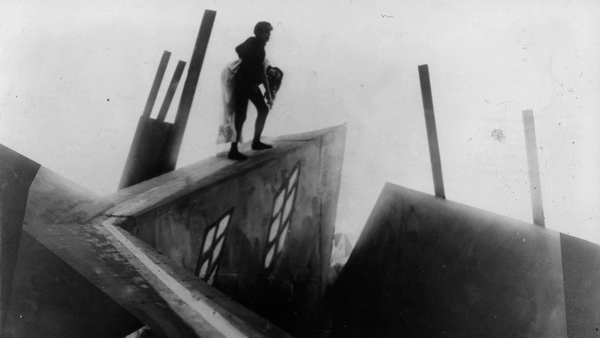
A notoriously difficult term to define, expressionistic art could be crudely described as that which seeks to convey emotional and psychological states, rather than a realistic representation of the world. In painting, the key period for expressionism was the early part of the twentieth century, especially in Germany. Identified by the use of distorting and exaggerated angles, intense colour, and a sense of terror or foreboding.
In Germany from 1920 Expressionist cinema began to develop, taking film as an art form in new directions which were distinct from the emerging Hollywood production methods. Directors like F.W. Murnau with Nosferatu and Robert Wiene in The Cabinet of Dr. Caligari employed techniques such as exaggerated use of angles, totally non-naturalistic set design and dark story themes which moved cinema away from attempts to be realistic: their influence has touched films such as Blade Runner, Batman, and Edward Scissorhands.
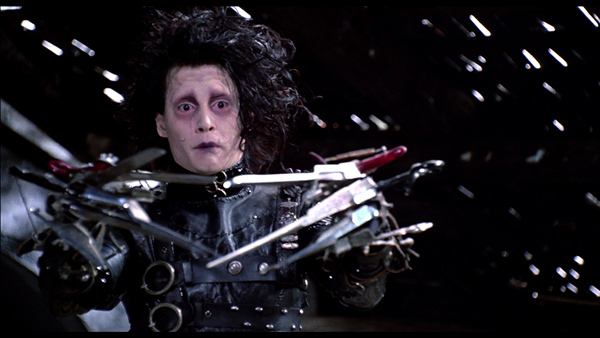
The rest of this section offers some suggestions for how expressionism and moving image can support learning in different curriculum areas.
Expressionism in History
It is often illuminating to look at artistic movements in the context of the historical period in which they developed. Europe during the first world war is a perennial theme in secondary school History, and the art coming out of Germany during that period is a really interesting insight into a world of moral and emotional turmoil.
Different perspectives
When looking at the poetry of Wilfred Owen / Rupert Brooke / Siegfried Sassoon, introduce some of the expressionistic German poetry as a point of comparison, there's an example below.
Battlefield
Yielding clod lulls iron off to sleep
bloods clot the patches where they oozed
rusts crumble
fleshes slime
sucking lusts around decay.
Murder on murder blinks in childish eyes.
- August Stramm 1915
This poem could be the stimulus for empathetic writing from the battlefield, as well as introducing a German perspective on the horrors of the war. This could also include some German expressionist painting – both of the battlefield and German life during the period. Some good ones to project would be Beckmann's The Night and Dix's Flanders and Skull. It is interesting to see how the new levels of savagery and inhumanity during that period gave rise to new forms of artistic expression. It might be useful to compare German Romantic art of the nineteenth century, with its idealised representations of the natural world and religious subjects, such as Joseph von Fuhrich's Jacob Encountering Rachel to see the effect of the War on visual art. Students could create their own digital story presentation about World War One using simple video editing software. This could include adding voice-over tracks to photographs and paintings from the period. Students could read examples of WW1 poetry over their images, or write their own poems or diary entries from the POV of a nurse, soldier in the trenches, General etc. This could also be done in the style of a news reel, either with sound or with silent movie titles and a choice of dramatic music and sound effects.
The art of the First World War could be contrasted with the propaganda of the period. In addition to early recruitment adverts, this film from the Scottish Screen Archive, Glasgow's Yesterdays can be used.
Suggested activities with the film
Input it into editing software and record a new soundtrack, this could be students giving context and information about troop recruitment, or a more artistic exercise, such as dramatised readings of wartime letters and diaries or poetry.
Compare this early recruitment propaganda with the most recent adverts by the Ministry of Defence in terms of the techniques used.
Expressionism in art and design
The German expressionist cinema of the 1920s represented a major breakthrough for cinema as an artistic medium - telling stories in a visual and narrative style unlike what had been seen previously. Whilst American cinema pioneers were refining techniques such as close-ups and highly detailed and realistic set construction on films such as D.W. Griffith's Intolerance (1916), German directors in the period after World War, under the influence of painters such as Otto Dix and Max Beckmann, developed a deliberately non-realistic form of cinema, where emotion and atmosphere triumphed over realism.
An important film was Robert Wiene's The Cabinet of Dr Caligari (1919). One of the film's designers, Hermann Warm described the process of working on the film in The Haunted Screen
We spent a whole day and part of the night reading through this very curious script. We realised that a subject like this needed something out of the ordinary in the way of sets. Reimann, whose painting in those days had Expressionist tendencies, suggested doing the sets Expressionistically. We immediately set to work roughing up designs in that style.
The influence of Expressionist painting and drama on The Cabinet of Dr Caligari can be seen in the film's use of extreme canted camera angles, exaggerated gestures by the actors and irregular distorted shapes. The film shows how cinema relatively early in its life absorbed the influence of visual art to develop a new artistic approach to film story telling. As cinema developed through the twentieth century it began itself to influence other art forms - an obvious example of this is in the development of comics.
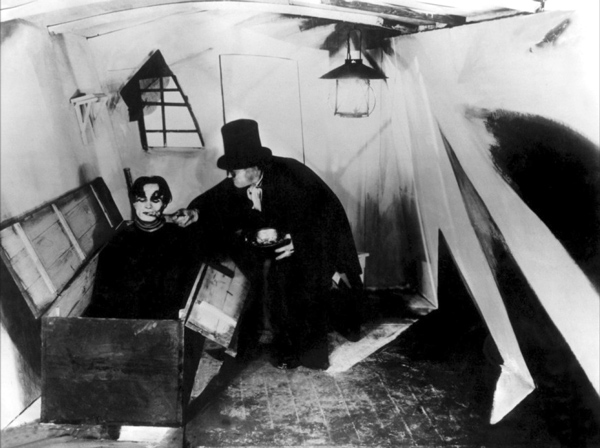
The distorted designs of The Cabinet of Dr Caligari
Set design
Looking at the history of production design is a great way to get students engaged with some of the many art and design elements of film.
The BFI's Creative Archive has a host of early, out of copyright films, which show how early cinema moved in its early days from being a scientific curiosity which was concerned with documenting life as lived, such as Panorama of Ealing from a Moving Tram (1901), to early developments of film storytelling which used staging conventions and techniques familiar from the world of theatre, such as Mary Jane's Mishap (1903), through to films which began to develop a distinctive look and technique specific to to cinema, with multiple locations, such as Daisy Doodad's Dial (1914), or artistic special effects and design, such as Georges Méliès's A Trip to the Moon (1902). Such early films are sometimes classed as primitive films.
Activities
It can be a fun creative exercise to ask pupils to storyboard, or make a very short film using expressionist film techniques; such as exaggerated body language, single location, intertitles, long shots. Simple computer editing software such as Imovie or MovieMaker can give that "1900s look".
As homework research ask students to find recent examples of media which has been influenced by expressionism. These could be film posters, TV and movie stills, web design, book covers, CD covers and music videos.
Ask students to prepare presentations comparing short extracts from expressionist films with expressionist paintings.
Key German expressionist films
Golem (Paul Wegner, 1915)
Metropolis (Fritz Lang, 1927)
Nosferatu (F.W. Murnau, 1922)
Raskolnikov (Robert Wiene, 1923)
Expressionism as an art form "died out" quickly in he second half of the 1920s. However, the influence of German Expressionist film has been a considerable influence on later cinema - perhaps most notably in the work of Tim Burton. This can be seen in the Expressionist cityscapes (with Oscar-winning designs by Anton Furst of Batman (1989), as well as Edward Scissorhands (1990) and The Nightmare Before Christmas (1994).
Expressionism in English
The film The Sandman is a very useful film in secondary English. It can be used to discuss the process of adaptation of written texts to the screen (the film is a loose adaptation of an E.T. Hoffman story), and also used to introduce the concepts of allusion and homage - how texts reflect the influence of other texts. The inspiration for the film comes from a very short section of the (much longer) Hoffman story:
...I at length asked the old woman who acted as my youngest sister's attendant, what sort of a man he was - the Sandman? "Why, Nathanael, darling, don't you know?" she replied. "Oh! he's a wicked man, who comes to little children when they won't go to bed and throws handfuls of sand in their eyes, so that they jump out of their heads all bloody; and he puts them in a bag and takes them to the half-moon as food for his little ones; and they sit in the nest and have hooked beaks like owls, and they pick naughty little boys' and girls' eyes out with them." After this I formed in my own mind a horrible picture of the cruel Sandman. When anything came blundering up the stairs at night I trembled with fear and dismay
This is an example of how a small detail of a written text can be the spark which inspires a filmmaker to create a new twist on the tale.
Discuss
Why do you think this section caught the eye of filmmakers as the starting inspiration for a film? Before showing the film to the class, ask them in groups to come up with a synopsis for a short film inspired by the above After watching the film The Sandman in class you could discuss what the filmmakers added to the film which isn't found on the text. Give your class short passages of longer texts which have a lot of interesting visual images and ask them in groups to devise a synopsis/storyboard for a film inspired by their snippet of text.
Allusion and homage
Novels, plays and poems do not exist in isolation, but are influenced by works of literature from the past. For example, the Harry Potter series reflects the influence of previous children's novels such as Tom Brown's School Days in the depiction of boarding school life, Roald Dahl's Matilda with her awful family, and Jill Murphy's The Worst Witch series.
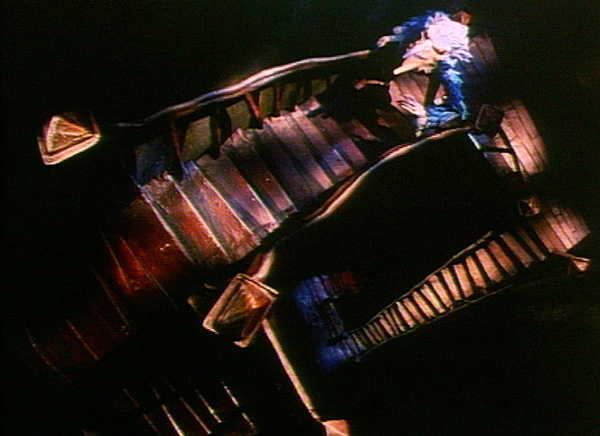
Films are no exception, and with over a century of high developed film culture to draw on it's no surprise to see film directors reflect the influence of what they have seen in their work. Direct references such as these are known as allusions or homages. The Sandman is very clearly influenced by German Expressionist cinema in the use of framing, character movement and set design. Another clear influence in shot types is the films of Alfred Hitchcock. The forward zoom/reverse tracking shot used at (time, or embed that clip) was first used in major film in the opening sequence to Hitchcock's Vertigo (1958) to depict the lurching sensation of the main character as he hangs from the roof of a tall building; also the top shot above is also a clear homage to similar framing in Hitchcock's Psycho (1960), where the top shot is used to conceal the identity of the body being carried by main character Norman Bates.
The distorted shapes of the set and dutch angle of the camera in this shot from The Sandman reflect the influence of German Expressionist cinema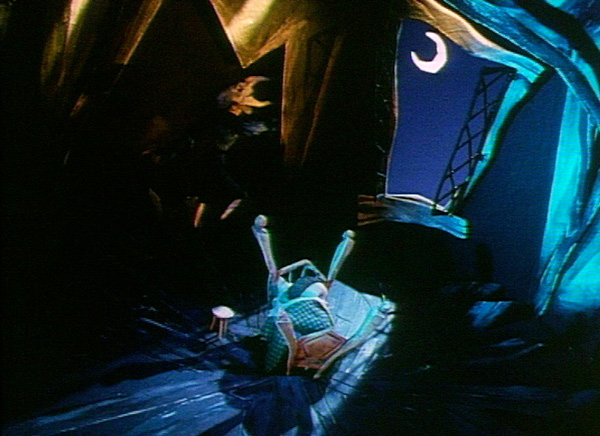
This top shot is an homage to Hitchcock's Psycho (1960)
Immature poets imitate; mature poets steal; bad poets deface what they take, and good poets make it into something better, or at least something different
Expressionism in drama
Showing students studying drama extracts from expressionist plays such as Elmer Rice's The Adding Machine, Eugene O'Neil's The Hairy Ape or Oskar Kokoschka's Murder, Hope of Women in contrast to the naturalistic plays of the late 19th century, such as Ibsen's A Doll's House shows how much drama changed - particularly in being free to be less 'realistic' in how it presented life.
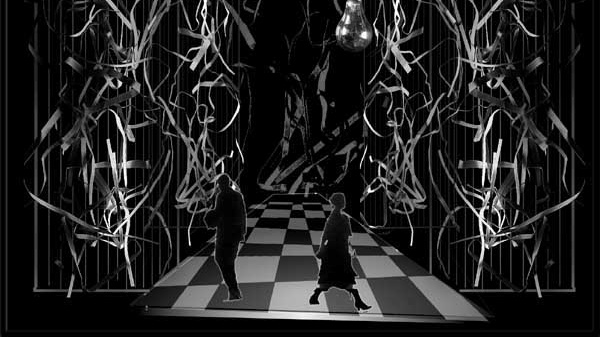

A contemporary production of The Adding Machine
Show students examples of expressionist set designs, such as The Adding Machine and The Hairy Ape.
The film 1985 film version of Death of a Salesman with Dustin Hoffman slides between expressionist and naturalistic design, depending on the central character's state of mind. You could show students contrasting clips, and ask how the film sends signals about how Willy Loman moves from reality to fantasy, thinking about set design, music, editing, lighting and acting. You could ask to design an expressionist set for the play they are studying.