Art Department
Everyone notices the production design in a lavish Hollywood sci-fi, however, each prop, colour and location has been carefully considered in a subtle low-budget domestic drama too.
Try to notice as much as possible and do not be afraid of 'borrowing' other people's ideas.
Collect ideas
- Look how bright and subtle colours contrast
- Look at the shapes of stylish furniture and the textures of trendy fashion and tatty clothes.
- Visit museums and galleries. Go to crazy places too
- Keep a sketch book to scribble in
- Take a camera with you when you go out. You never know where you might find ideas.
- Watch the play of light across your kitchen table
- Watch a lot of TV and films
Inspiration box
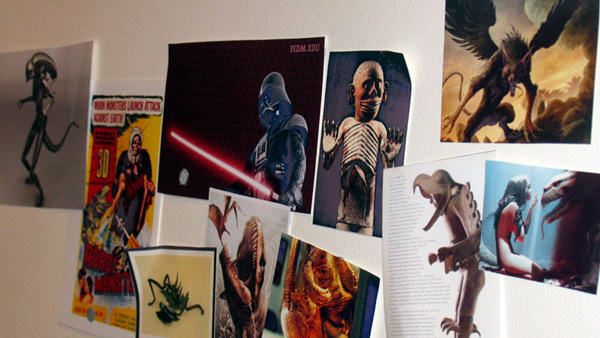
You have to know what you like, you also have to know what you find nasty. Not all things in films are nice. You need to have ugly things up your sleeve too! Get a box and put bits into it, cut out snippets, snapshots, bits of packaging, leaflets, etc. Collect whatever takes your fancy. When you are starting a project, dive into the box for inspiration and pin up things you think might be useful. And make an "inspiration box" on your computer too.
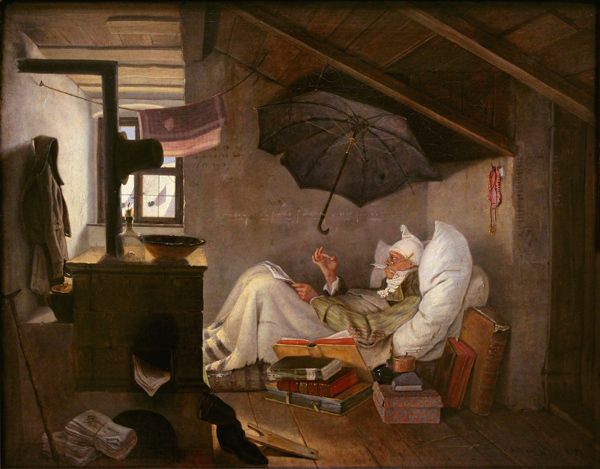
Try to notice as much as possible and do not be afraid of borrowing from other people's ideas.
I steal from every movie ever made
Thinking about composition
Look at how images are put together, and how the screen rectangle can be split up.
Verticals and horizontals
Vertical lines can split the screen up into two or more parts. They make the image more interesting. For example a lamppost, a tree trunk, or the edge of a door frame in the foreground. Horizontals can be useful too.
Diagonals
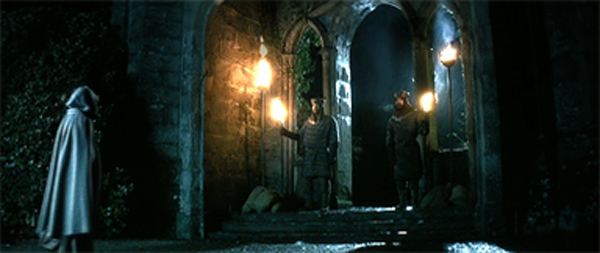
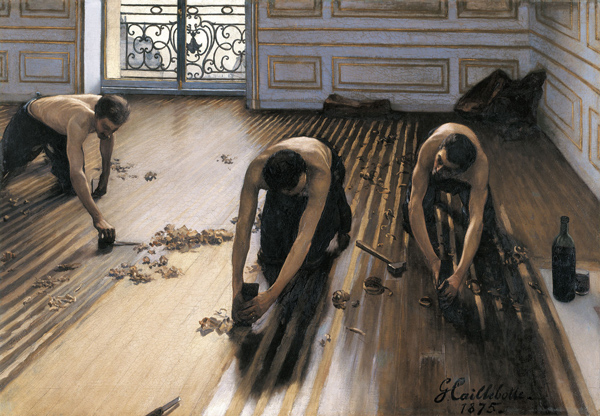
Diagonals are usually more dynamic than horizontals and verticals. Buildings, rooms and roads often give exciting diagonals.
Pictures within a picture
Pictures within a picture (such as views through windows, doorways and into mirrors) often imply hidden depths.
Exercise
Experiment with a stills camera in a living room. Include two pieces of furniture. e.g. a TV and a sofa. Move them into opposite corners of the room. Then close together so you can get behind the TV and sofa. Use different angles. There is no such thing as a factual photo of this room. You have to decide what story you want to tell
Get the bigger picture
Read the script plenty of times with an open mind, just get to know the story and the characters. Grasp one or two words to describe the overall mood (e.g, aggressive, funny). Consider the direction you think the film is going to take stylistically. Is it a horror film, a domestic drama, a surreal film? Focus on this ‘bigger picture’ first. The other 'mini-moods' can fit in later.
Research
Now you have an idea of mood, you need to research carefully to find the best references and inspiration. Go to the library and scour the internet; if you are not sure how to design something, find out how others did it: Ask film buff friends to recommend scenes, and view them shot by shot. Dig into your inspiration box.
If it can be written, or thought, it can be filmed
Consider colour
Colours are emotions. Try a muted colour scheme, such as earth colours, or whites, with occasional strong colours. These then stand out and look powerful. Colour can often underline good, evil, cool or hot-blooded characters.
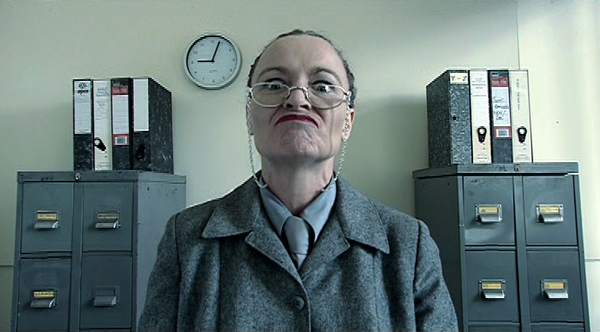
Contrasting colours emphasize contrasts between characters. Characters' clothes often blend-in with their environment when they are at home. But a visitor might wear a contrasting colour. The audience does not consciously notice this, they just feel it is right.
Keep a scrap book for the main characters and sets. Stick in references, colour swatches, details, etc. and work closely with these whilst preparing costume.
Make lists
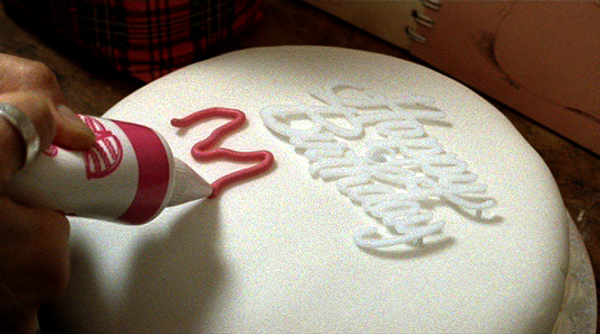
Next make a long list of all the places and props in the script. (e.g. bicycle, bunch of flowers, sandwiches, a birthday cake, country road, sitting room, door key). Try not to forget anything. Some things will get added. Some will get crossed out. Some get a question mark.
Visualise
Sketch visuals to get a feel for how things could look. Think about composition; think about what shapes might be in the foreground, mid-ground and background. You don't have to do good drawings. Rough sketches are fine. But the mood should be clear if possible.
Don't worry if you can't draw well. There are many ways to communicate your ideas with your team clearly. Print out photos, scribble on top, cut out stuff, stick on extra bits, draw pin men. Practically any method will do
Budget & time
By now, you should have some idea about how much time and money you have at your disposal. You have to divide both up carefully because they can disappear rather quickly. For example, in a sci fi film you want a robot. There may be cheap and easy ways to make him. Do you need to buy those steel bathroom fittings to make the arms, or can you get away with insulation tube wrapped in aluminium foil? If you have people who are helping you, like a good carpenter, ask them lots of questions about how to do things and provide them with some good drawings. Keep your options open for as long as possible. (Of course, one option is to scrap the robot!) Don't make the robot just yet!
Locations
You are probably not going to build a set in a studio, so you have to scout around and find good locations. What looks good in real life is not always the same as what looks good on film. Look for bold outlines. The curve of a beach or the slope of a hill in the background. Look for higher and lower levels like steps, balconies, cellars, and ladders which mean you can use high and low angles. If safe, they can really add to the film's dynamics.
Take a tape measure and draw a rough plan. Photograph things to jog your memory later, and as a way of seeing what the camera sees. Also photograph someone at the location for scale.
Change the geography. The wide of a house may be one particular house, the CU of the front door may be from another house. Although the hallway, the sitting room and the garden are linked in the film, they do not need to be linked in reality. If the camera does not show the wrong wallpaper through the door, nobody will ever know.
Organising a location can be a tricky. Transport, parking, keys, access, times, other people using the space, getting in and out, permission for what you can and can't do, access, additional costs, etc. Always keep these practicalities at the back of your mind. Often it means you have to scrap a potentially exciting location.
Adapting locations
How are you going to adapt the location? Should the space look sparse or cluttered? How you are going to dress the set? Hang up curtains? Re furniture? Bring in other furniture and props? Vary details to imply day and night.
Think about light sources. e.g. anglepoise lamps, lampshades, candlelight, parked car headlights, the camera dept will thank you for including these practical lamps.
Create more visuals (see earlier) when you have an actual location.
Props and furniture
Don't ignore boring things like tea cups and kitchen chairs. Scour junk shops and friends' living rooms. Try to get things which have real personality and are right for the character or scene. Make simple alterations and additions as appropriate (e.g. nasty biscuits on saucers, bright cushions for the chairs).
Look for props that move! e.g. thin net curtains moving very slightly in the breeze, a slowly rotating fan, goldfish
Assume actors might need to use the furniture and pick up the props. Make sure they are stable and presentable from all angles.
On set
Once filming, watch carefully. Concentrate hard. You need an eagle eye. Move the furniture and props around so that they look right. When repositioning props after camera set-up, check with the cinematographer or director. It might be positioned for a reason.
Weather
Bad weather can wreak havoc. You might stand in drizzling rain all day. Are your props water and windproof? Many nice weather scenes are filmed on grotty days. During shooting there are always a few disasters. You'll do a lot of running around gaffer taping things down, or charging off to the shops to buy something. Learn to improvise!
Roles: production designer, art director
Materials & Equipment
Portable stands
- Artist's easels
- Music stands
- Tripods
- Parasol stands (the sort you fill with water)
- Concrete bases (poured into plastic bags)
Fixing methods
- String
- Wire
- Rope
- Cable ties
- Good gaffa tape (black and white)
- Safety pins
- A top quality staple gun (4mm and 9mm)
- Repositionable spray mount (so you can stick things onto walls and then remove them)
Building things
- Thin iron bars from a builders merchants (those used in reinforced concrete) light, bendy, stable & cheap)
- Construction foam (light & strong, but remember it expands)
- Car filler (two component type)
- Chicken wire
- Papier-mache (add wood glue to the wallpaper paste to make it a bit more waterproof)
- Heating-pipe insulation tubes
- Camping mats to cut up
- Polystyrene and polystyrene paste (you can't stick polystyrene with normal glue)
Other
- Watery black emulsion with a bit of olive green for making things dirty and old
- Electric fans for blowing stuff around